
* Y P * P Y *
ZXCVBN
The Greater Planetary Glyphs
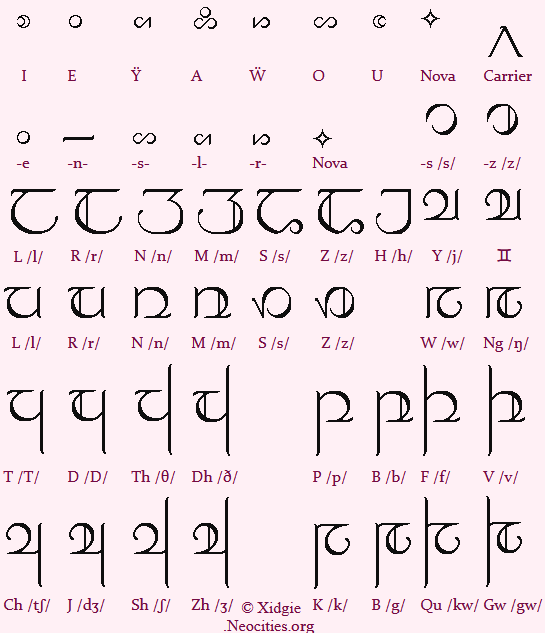
The Greater (Infixion) Planetary glyphs are like gas giants and represent the liquids, nasals, and sibilants that can easily come before median planetary glyphs. They differ from their Lesser pairs in that they can take stellar vowels and in fact are only written when they do.
The Greater L is the first glyph that the people who made Lumellis ever created and considered the most important, representing light (R represents darkness). It's shape, you may notice, is present in most every other planetary glyph in the script. The N represents a person while the M represents the embrace of a parent holding their child in a swaddling cloth, and the S and Z represent the base L/R with a comet tail, a shooting star, referred to as the Greater Comets.
zxcvbn
The Lesser Planetary Glyphs
The Lesser Planetary glyphs are like dwarf planets and are twins to their Greater counterparts, but only appear where they would not take a Stellar Vowel. They are also used where Stellar Infixions would be used but cannot, as Greater glyphs cannot take Stellar Infixions. While the Greater forms cannot take stellar infixions, the Lesser forms can. They are also used when two Greater glyphs, or an H, would be written side by side with a dim vowel, to promote space and to make the word look more beautiful. While the Lesser L, R, N, and M are called just that, lesser, the lesser S and Z are called the Lesser Comets.
asdfghjk
ASDFGHJK
l;ML:
The Median Planetary Glyphs
The median planetary glyphs are carriers that have their own sounds that do not have any special rules and the most flexibility as carriers. They are the remaning consonants.
They take stellar vowels, stellar infixes, and possibly an even lower illuminant or nova.
Clusters of consonants of any kind are refered to as planetary clusters, however they have no special pronunciation rules, either.
The only exception is H which only takes a central star and top star because of its shape.
The ; is ♊︎ which is a gemini symbol, it means that it geminates (or twins/doubles) the planet that follows it: ♊︎t is transcribed as "tt". It has no sound on its own and primarily serves to sever links from vowels and the illuminant if needed.
The T, D, Th, and D planets are collectively called the T orbit.
The P, B, F, and V planets are collectively called the P orbit.
The Ch, J, Sh, and Zh planets are collectively called the Ch orbit.
The K, G, Qu, and Gw planets are collectively called the K orbit.
H has its own unique orbit that crosses median and greater orbits.
[ ] { }
The Comet Tails
Comet tails represent the sibilants added directly to greater, lesser, and median planetary glyphs to form ligatures. They come in four variants, two each for -s and -z respectively, one facing down the other up. While you can choose which one to use for the T and Ch orbits, the others only take specific facing comets because of their shapes. The comet tails attached to greater comets are called meteor showers, coming in Ss, Sz, Zs, and Zz forms.
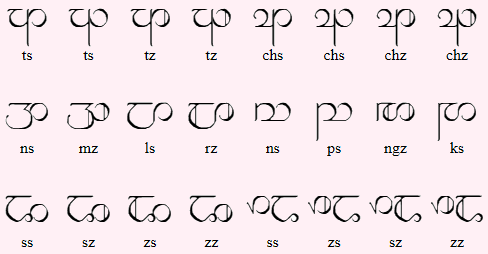
The differences between the first four double comet ligatures and the second four comet clusters is where they are used. Where there needs to be space placed between the greater comet and another greater glyph or H, the first four are used. In some situations, it may be down to preference, but the second set of four are rare.
* Y P * P Y *
The links below cover everything about using Lumellis outside of a computer. If you would like to view the detailed .odt document, which covers what is in the links and how to use the font on computers please follow here: