
* Y P * P Y *
AXr/cGEXq/gDuc
Transcription
The currently available transcription modes for Lumellis is Universal and English, at a later date that may change to include other language modes. Please stay tuned $m
@wHWZqD
Transcribing English
Using the English Mode is the basis of transcribing English into Lumellis. There are a few spelling rules to follow as well as short forms to consider which are combinations of planets and stars that should be otherwise unintelligible standing for a sort of acronym for a word or part of a word, usually the beginning, possibly the ending, but never the middle.
A few rules revolve around the transcription of the sound /ə/ which the Lumellian script does not have a designated glyph for, but in limited form in Universal Mode (which is shared in English mode) and in some capacity utilizing short forms unique to English Mode, the /ə/ sound in some instances can be accounted for.
First is the /ɝ/ sound, which can be transcribed as /əɹ/, the central sound in "learn", which is primarily written as ẅr, and perhaps optionally as ӱr because the ӱ's native sound is simply not used in most languages.
Second is the "le" sound in "little" which is usually written as /əl/ in IPA; this is understood within Lumellis to be ẅl /ʊl/ as a symmetrical sister sound to ẅr.
The last /ə/ deals with the sound when beginning words, usually being written with an A. The short form of the word "a" is a mountain carrier with a single illuminant under it - this is to show that the sound is not only very simple, but it is up to the reader's discretion to pronounce it as /ə/ or as /ej/. The other short form that functions the same way is "the" for /ðə/ or /ðij/, represented by a Dh glyph with a lone illuminant underneath. Other short forms that are written the same way with an unconnected illuminant reference the closest sound of the smallest word in English that it might refer to, such as gQ meaning "up" and aQ meaning "it", both of which can be used to write words that begin with those sounds such as "upwards" and "itself" because those lone initial illuminants are unreadable otherwise.
Because the ӱ has no real practical use in English Mode, it is permissible to use a dim ӱ in place of a dim i, but the illuminated ӱ is still required separately.
For the rare clicked T, a T is simply used such as in "water".
For the affricate sounds that occur when combining T and D with R ("tree", "dream"), the affricates are written instead unless preferred otherwise. This gives more clarity to pronunciation and lets the affricates be used more often in writing.
The apostrophe ('s) is written out in Lumellis, the s becoming a z when applicable and the apostrophe being represented by an bar in the upper stellar position over the s or z.
HYyzZu//v]mp XPq/: | Gollum'z Ring |
foQ Cq/aQ[p hluaQw | Dhe nite's byuetë |
The apostrophe is also written on other places where possible, such as "it's", and "you're", “we're”, and “I’ve”. These don't change pronunciation in any way.
aQ[p | it's |
lyxQp | you're |
LwxQp | we're | @qYkpQ | I’ve |
$iQ
Short Forms
The general rules of writing don't apply in the creation of short forms. The majority of rule breaking in short forms is because they cannot be read as anything else that makes sense. If you ever see a word on its own that doesn't make sense, or the first part of a word, check to see if its a short form of something.
In general the short forms make some amount of sense, such as the lone illuminant under a single planetary glyph representing a preceeding /ɪ/ or /ə/, or an S infixion representing a preceeding O, or an S infixion plus lower illuminant representing a preceding A.
A nasal bar, either below or above is as likely to reference "the" in combination abreviations just as much as a nasal sound.
Assume all short forms with an initial illuminant can begin any English word, such as "itself" and "also", as long as it cannot be reasonably confused for illuminating another vowel. ("itself" would need the illuminant under the F to illuminate the E, and the ending O is already "illuminated" by the ending position - "lsoe" in unpronounceable.
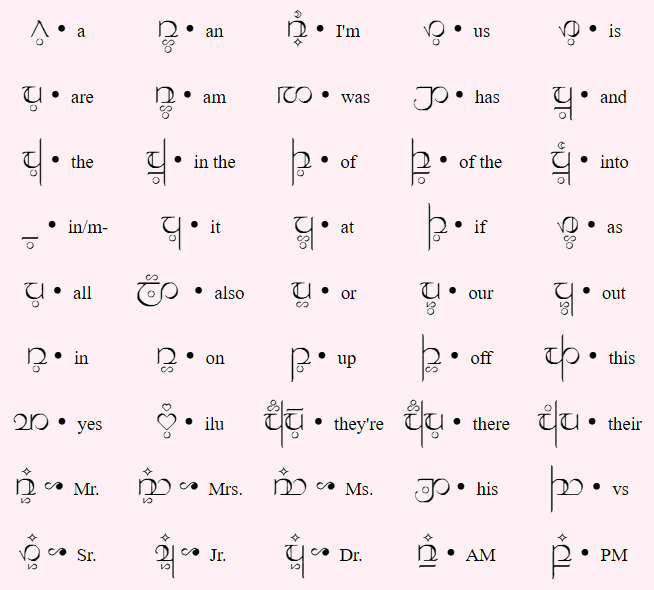
* Y P * P Y *
The links below cover everything about using Lumellis outside of a computer. If you would like to view the detailed .odt document, which covers what is in the links and how to use the font on computers please follow here: